Key leadership theories and lessons you can use today to lead better
Introduction
Embarking on a leadership journey in healthcare is a unique adventure. It requires blending clinical expertise with the art of working towards a goal greater than oneself. One question trainees and aspiring leaders often ask is: What kind of a leader would I like to be? Have you thought about this?

We are hungry to learn about leaders, listen to their stories, trying to extract lessons from their journey that can help us find our tuning to sing our song. Understanding and applying key leadership theories is a crucial step in this exploration. Yet anecdotally, opinion is sharply divided on whether it is worthwhile teaching leadership theories to trainees in healthcare. None was ever mentioned to me in a decade of physician leader training, and only one made it to our MBA leadership program.
This two-part series breaks down select theories, narrates them through relatable healthcare scenarios, shares key lessons learned, and suggests practical steps you, as emerging leaders, can implement today to enhance your leadership skills.
In the first part of our exploration of leadership theories, we delve into three pivotal concepts that stand at the forefront of leading effectively in healthcare. We begin by distinguishing between ‘Management versus Leadership’, uncovering the balance between task orientation and visionary guidance. Next, we tackle ‘Transactional versus Transformational Leadership’, examining the day-to-day exchanges that underpin routine operations and contrasting them with the inspirational drive that propels teams towards broader, collective aspirations. Finally, we discuss ‘Servant Leadership’, where the leader’s focus is on serving their team, empowering them, and fostering their development.
In the second part, we will complete our deep dive and put it all together to see how we can form a mental model to best develop our leadership over time.
Key Leadership Theories and Their Applications
These are the seven theories we will cover in this two-part post. If this feels like too long of a detour for you, skip to the one theory you are most curious about.
- Management versus leadership
- Transactional versus transformational leadership
- Servant leadership
- Authentic leadership
- Path-goal theory
- Emotional Intelligence Based Theories
- Adaptive leadership
(Note: In this first of two posts, we will go over 1-3, and in the second post, we will complete our deep dive and put it all together. )
1. Management versus Leadership

A Healthcare Story: As an infectious diseases physician treating a newly diagnosed patient with HIV, my role intertwines management with leadership. Initially, it’s about efficiently and effectively collecting medical history, conducting exams, ordering tests and handling prescriptions within the allocated time and resources.
But more than that, it’s about leading – discussing life beyond the diagnosis, envisioning a future of health and hope, building a shared plan, and empowering the patient with resources to tackle key challenges.
And let me emphatically add here that the acts of managing and leading are by no means limited to physicians; everyday I see our HIV program case managers displaying an even greater range of these skills in working with our patients.
One Key Lesson: Balancing the execution of management with the vision of leadership is crucial.
What You Can Try Today:
- Management: Each morning, identify your top 1-3 priorities. Create a checklist of smaller tasks that aligns with these priorities. Check off/add tasks as the day unfolds, and review your process daily to learn and improve. Reflect on how this process not only improves your execution skills but also leads towards your goals by clarifying your priorities.
- Leadership: Next time when you are in a clinical scenario with a patient who has received a major diagnosis, consider the distinction between managing and leading. Who is leading? What is the shared vision, the strategy, and the team?
One Good Resource: Harvard Business School Blog: https://online.hbs.edu/blog/post/leadership-vs-management
2. Transactional versus Transformational Leadership:
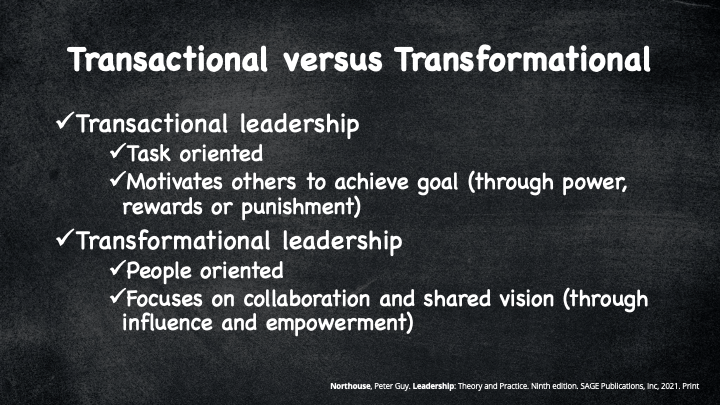
A Healthcare Story (Transactional leadership): Imagine you’re navigating the busy day at your university hospital, where small but significant transactional interactions are part of the routine. These seemingly minor exchanges are what keep the daily life of the hospital flowing smoothly.
- Cafeteria Checkout: You’re in the cafeteria, balancing a tight schedule between rounds. With a sandwich and a coffee in hand, you join the checkout line, swipe your card, grab the receipt, and offer a quick nod or a “thanks” to the cashier. In this brief exchange, there’s a mutual understanding of the need for speed and simplicity. You’re on your way in no time, fueled for the next part of your day.
- Asking for Directions: As you stride through the hospital’s corridors, you’re approached by a visitor looking lost, their brows furrowed in confusion. “Excuse me, could you help me find the cafeteria?” they ask. You pause, putting aside your immediate concerns for a moment. Offering clear directions, you even point out a couple of landmarks to help them on their way. Their grateful smile as they head off is a reminder of the impact these small acts of assistance can have.
Beyond Healthcare: Nelson Mandela, transformational leader in action
- Nelson Mandela, an epitome of transformational leadership, demonstrated his profound impact during his presidency in post-apartheid South Africa. Imagine a scene in the early years of his presidency: Mandela stands in a room filled with leaders from diverse ethnic and political backgrounds, some of whom were once his oppressors. With a commanding yet compassionate presence, he articulates a vision of a united, peaceful South Africa, transcending past conflicts and divisions. Mandela listens attentively to the concerns of all present, acknowledging their fears and reservations, yet gently challenging them to rise above their personal and historical grievances for the greater good of the nation. In this moment, Mandela is not just governing a country; he is reshaping and inspiring a collective consciousness, fostering a sense of shared purpose and optimism amidst a deeply scarred society. His leadership style is transformational in its purest form, as he elevates the aspirations and moral standards of an entire nation, guiding them towards reconciliation and progress.
- Mandela’s interaction with the Springboks during the Rugby World Cup exemplifies how he transformed seemingly ordinary transactions into powerful, symbolic acts of unity. Before the game, Mandela took the time to meet each player individually, an act that in itself was a simple transaction. However, he elevated these moments into something profoundly meaningful by memorizing each player’s name and background, a gesture that resonated deeply with the team. This wasn’t just about politeness or formality; Mandela was sending a clear message of inclusivity and respect, breaking down longstanding racial and cultural barriers. In doing so, he turned these brief encounters into pivotal moments of connection and reconciliation, demonstrating how even small, transactional interactions can be imbued with transformative significance when handled with intent and empathy.
One Key Lesson:
- Transactional Leadership: Managing routine tasks and maintaining high standards is important – but don’t forget that people are more important than tasks, and leadership is ultimately about people.
- Transformational Leadership: Inspire – but ensure you set the stage for your team to be ready and willing to embrace change. And remember, change is specific, tangible and incremental whereas transformation involves a fundamental shift in identity.
What You Can Do Today
- Transactional Leadership: Begin to notice times in your day when you are going through a transaction mindlessly. Give it your full attention and try to honor the dignity of the people involved in the transaction. What impact does this have on you and the other person?
- Transformational Leadership: Identify a change that you believe would benefit your team or patients. Discuss this with your colleagues, encouraging them to think creatively about how to implement it. Observe their reactions and willingness to embrace this change.
3. Servant Leadership
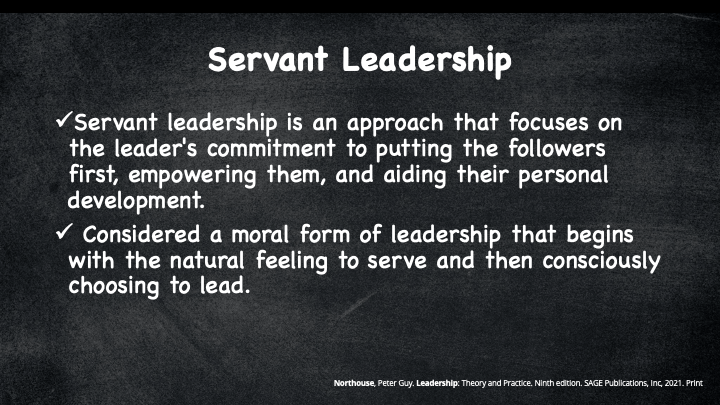
A Healthcare Story:
Imagine my first month as a medicine intern in a bustling hospital ward in Delhi, India. The ward was a hive of activity, often with two or three patients per bed, each facing a critical health challenge. This was the arena of my early medical training over two decades ago.
In this overwhelming chaos, one figure stood out as a beacon of servant leadership: the ward’s charge nurse. She was more than a guide; she was our ward’s anchor. Arriving an hour before us, she anticipated our needs as new interns, filled gaps in our knowledge, and even fed us when our packed schedules left no room for a break.
Her influence went beyond professional mentorship; it was a personal upliftment. She was there to teach us not just the clinical skills but also how to endure and adapt in the face of relentless pressure. Her selfless leadership, deep commitment, and unwavering support were my first lessons in what it truly means to lead in healthcare. Her impact on my approach to medicine and mentorship remains with me to this day.
Decades later, reading about Paul Farmer’s exemplary servant leadership in Mountains Beyond Mountains profoundly influenced my choice to go into Infectious Diseases.
One Key Lesson:
While profoundly impactful, it requires a delicate balance to avoid becoming overly involved, burned out or neglecting other responsibilities.
What You Can Do Today:
- In your next patient interaction, practice active listening. Instead of focusing only on the clinical symptoms, pay attention to the patient’s emotional state and non-verbal cues. Offer words of comfort or consider actions that acknowledge their experience beyond their illness. Notice how this changes the interaction.
- Reflect on a team member who might be facing challenges, either personal or professional. Reach out to offer support, whether it’s providing a listening ear, inquiring what they may need or sharing resources that might help them. Notice how this impacts your relationship. Remember, servant leadership also applies to how you support your colleagues.
One Good Resource: Mindtools Blog https://www.mindtools.com/ad648ub/servant-leadership
What’s next:
So far, we have looked at three common leadership theories trying our best to relate them to everyday scenarios and put them to use to make our lives and those of others better. Stay tuned for the next installment of our leadership journey where we’ll explore the nuances of Authentic Leadership, Path-Goal Theory, Emotional Intelligence Based Theories, and the ever-critical Adaptive Leadership.
Prepare to uncover deeper insights into leading with authenticity, strategizing towards goals with empathy, nurturing profound professional relationships, and adapting to the relentless tides of change in healthcare. These insights and stories will help equip you with the tools for leading better. Join us as we continue to unravel the “what”, “how”, “who”, and “why” of leadership and its profound impact on our professional and personal growth.
You decide (and share in the comments section):
- Which of these leadership theories so far resonates most with your personal experiences in healthcare, and why?
- Have you encountered a situation where a particular leadership style made a significant impact, either positive or negative?
- What’s missing in the theories we have touched on so far that may help you in your leadership development?
 Rahul Anand MD